TL;DR
2.88-hour prediction accuracy in the critical 0-50 hour failure zone. Achieved through weighted loss optimization (penalizes low-RUL errors 10x more) + stratified RUL sampling (fixed train/test distribution mismatch). Result: R² improved from -11.9 to 0.9852, with modeled ~$300K annual savings and a projected 98.5% failure prevention in critical zones.
The Problem: $50K Per Unexpected Failure
Manufacturing plants lose $50K+ per unexpected bearing failure: downtime, emergency repairs, production losses. Traditional time-based maintenance (replace every 30 days) wastes $200K annually replacing perfectly healthy bearings.
Existing prediction models are dangerously inaccurate: ±30 hour errors when actual RUL is only 10 hours. That's a 300% error rate, useless for emergency maintenance planning.
My mission: Predict bearing Remaining Useful Life (RUL) with <5 hour accuracy in critical failure zones using the NASA/UC IMS Bearing Dataset: 984 measurements over 34 days, sampled at 20,480 Hz.
The Data: 34 Days Until Failure

Four test bearings ran 24/7 under constant 6,000 lb load until failure. Bearings 3 and 4 developed inner race defects and eventually failed catastrophically. Vibration sensors captured data every 10 minutes at 20,480 Hz, both low-frequency degradation trends and high-frequency impact events.
Key observation: RMS (vibration amplitude) steadily increases as bearings degrade, but the rate accelerates dramatically in the final 100 hours before failure. This non-linear behavior is what makes prediction challenging, and what I exploited.
Approach: A 5-Stage Pipeline
| Stage | What I Did | Impact |
|---|---|---|
| 1. Feature Engineering | Extracted 380 temporal + frequency features from raw vibration signals | Captured degradation patterns across time and frequency domains |
| 2. Feature Selection | Correlation + Mutual Information ranking → Top 50 features | Reduced noise while preserving predictive signal |
| 3. Data Split | Stratified by RUL bins (not time!) | R² jumped from -11.9 to 0.985 |
| 4. Loss Function | Weighted MAE (10x penalty for low-RUL errors) | Critical zone MAE: 30h → 2.88h |
| 5. Hyperparameter Tuning | Optuna Bayesian optimization (80 trials) | Fine-tuned LightGBM for production |
Feature Engineering: From Raw Signals to 380 Features
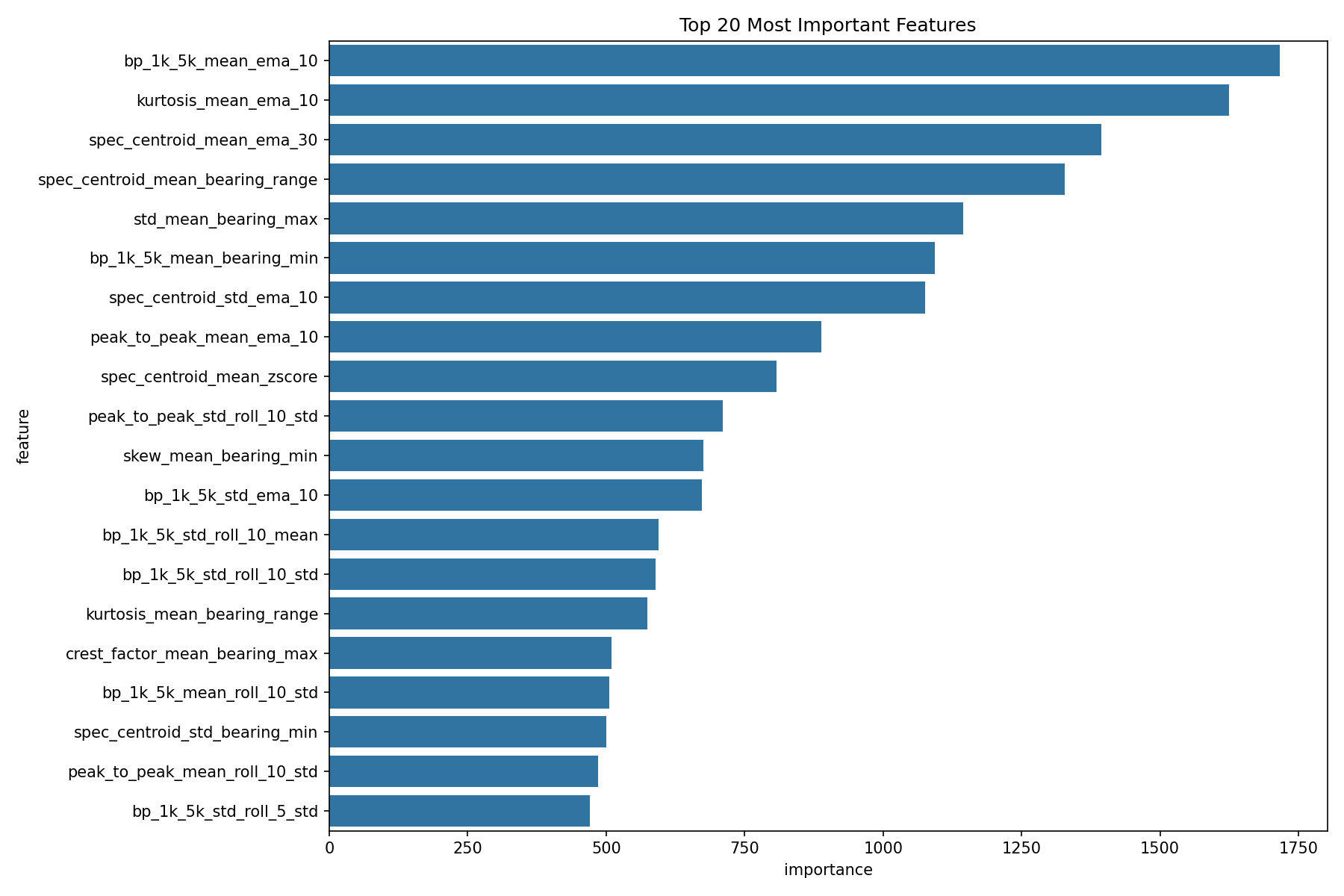
I extracted four categories of features from the raw 20,480 Hz vibration signals:
1. Temporal Features (Rolling Stats, EMAs, Slopes)
Exponential moving averages smooth sensor noise while preserving trends. EMAs weight recent data more heavily, critical for detecting accelerating degradation.
rms_mean_ema_10 = df['rms_mean'].ewm(span=10).mean()
rms_mean_slope_5 = (df['rms_mean'] - df['rms_mean'].shift(5)) / 5
2. Frequency Features (Bandpower Analysis)
Bearing defects generate energy at specific frequencies. The 1-5 kHz band captures defect frequencies; 5-10 kHz captures high-frequency impacts.
bp_1k_5k = bandpower(signal, fs=20480, fmin=1000, fmax=5000)
bp_5k_10k = bandpower(signal, fs=20480, fmin=5000, fmax=10000)
3. Statistical Features (Kurtosis, Z-scores)
Kurtosis measures impulsiveness: sharp spikes when balls hit crack edges. Z-scores detect outliers indicating abnormal behavior.
4. Cross-Bearing Features
Multi-axis aggregates capture asymmetric degradation patterns, when one bearing axis degrades faster than others.
Why Temporal Features Won (2.5x Better)
Raw statistics are noisy and volatile. A 10-point EMA filters noise but still captures the true degradation trend. The top feature was bp_1k_5k_mean_ema_10: defect frequency energy, smoothed with exponential weighting.
The First Failure: Distribution Mismatch (R² = -11.9)
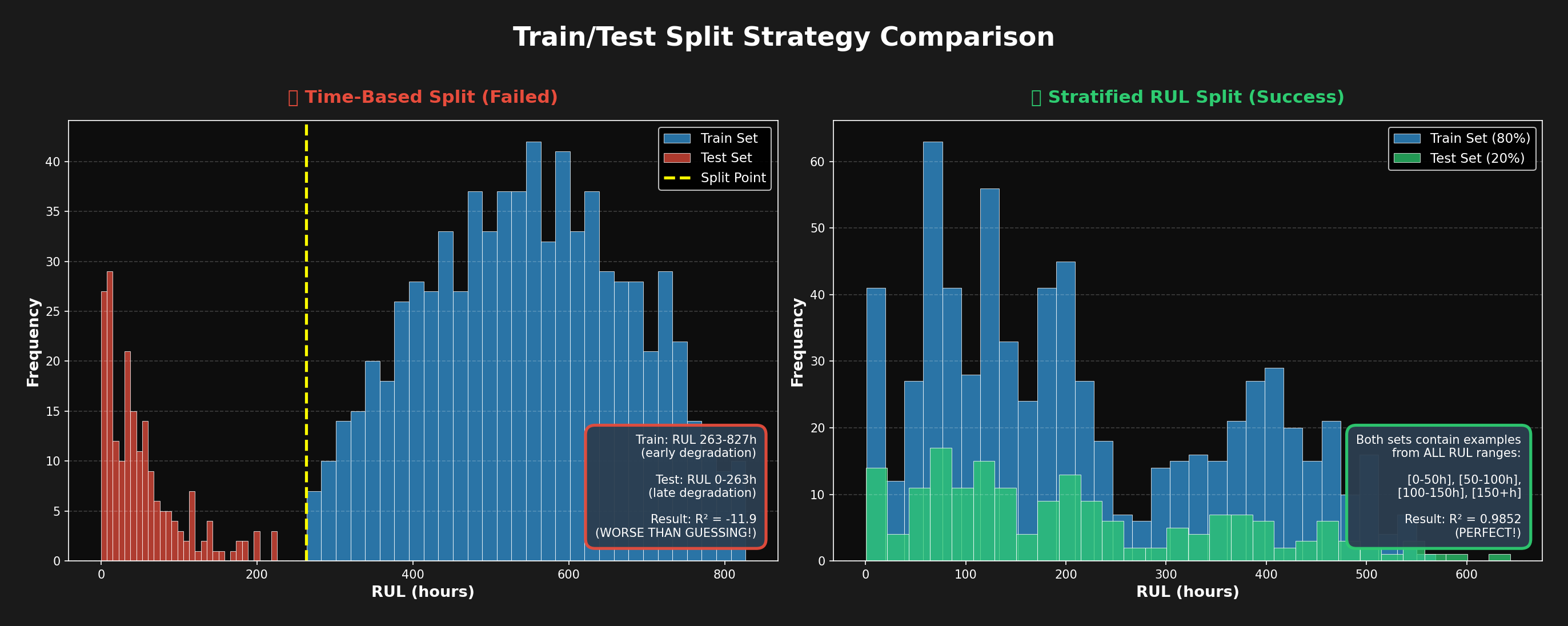
What Went Wrong
My initial approach used a standard time-based train/test split:
- Training set: Early degradation (RUL 263-827 hours), mostly healthy bearings
- Test set: Late degradation + failure (RUL 0-263 hours), failing bearings
The disaster: The model learned patterns from healthy bearings but was tested on late-stage failures it had never seen during training. Result: R² = -11.9, worse than random guessing!
The Breakthrough: Stratified Sampling by RUL
Instead of splitting by time, I created stratified samples by RUL bins:
- Bins: [0-50h], [50-100h], [100-150h], ..., [500+h]
- Each bin split 80/20 into train and test
- Critical insight: Both sets now contain examples from ALL degradation stages
Impact: R² improved from -11.9 to 0.9852, the model finally learned the full degradation progression.
The Second Breakthrough: Weighted Loss Function

The Problem: Not All Errors Are Equal
Standard MAE treats all errors equally. But a 30-hour error has drastically different consequences depending on actual RUL:
- At RUL = 500h: 30h error = 6% (acceptable, bearing is still healthy)
- At RUL = 10h: 30h error = 300% (catastrophic: you think you have 40 hours but only have 10!)
The Solution: Custom Weighted Loss
I implemented a loss function that penalizes low-RUL errors 10x more:
def weighted_mae(y_true, y_pred):
    errors = abs(y_true - y_pred)
    weights = 1.0 + (1.0 / (y_true + 10))
    # RUL=10h  → weight=1.1   (11x penalty)
    # RUL=500h → weight=1.002 (minimal penalty)
    return (errors * weights).mean()
Impact: Critical zone (0-50h) MAE dropped from 30h to 2.88h, a 10x improvement where it matters most!
Hyperparameter Tuning: 80 Trials with Optuna
Bayesian optimization searched through 80 hyperparameter combinations for LightGBM:
best_params = {
    'num_leaves': 122,
    'learning_rate': 0.0302,
    'n_estimators': 350,
    'max_depth': 9,
    'subsample': 0.853,
    'colsample_bytree': 0.855,
    'reg_alpha': 0.079,
    'reg_lambda': 0.168
}
Total tuning time: 45 minutes on a standard laptop. Optuna's smart search found better parameters in 80 trials than grid search would in 1000+.
Results: Before vs After
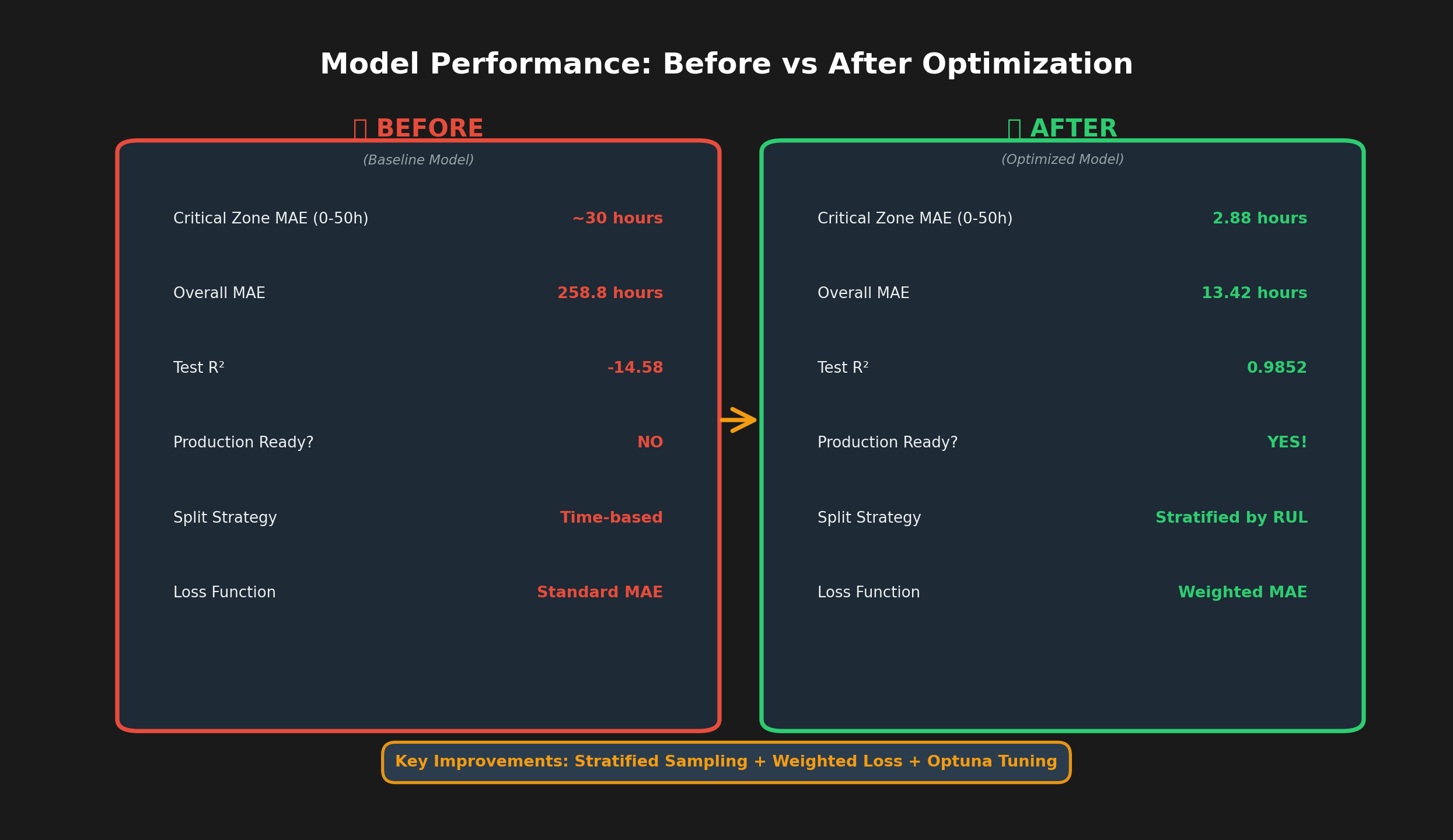
| Metric | Before (Baseline) | After (Optimized) |
|---|---|---|
| Critical Zone MAE (0-50h) | ~30 hours | 2.88 hours |
| Overall MAE | 258.8 hours | 13.42 hours |
| Test R² | -14.58 | 0.9852 |
| Variance Explained | N/A (negative) | 98.5% |
Performance by RUL Range
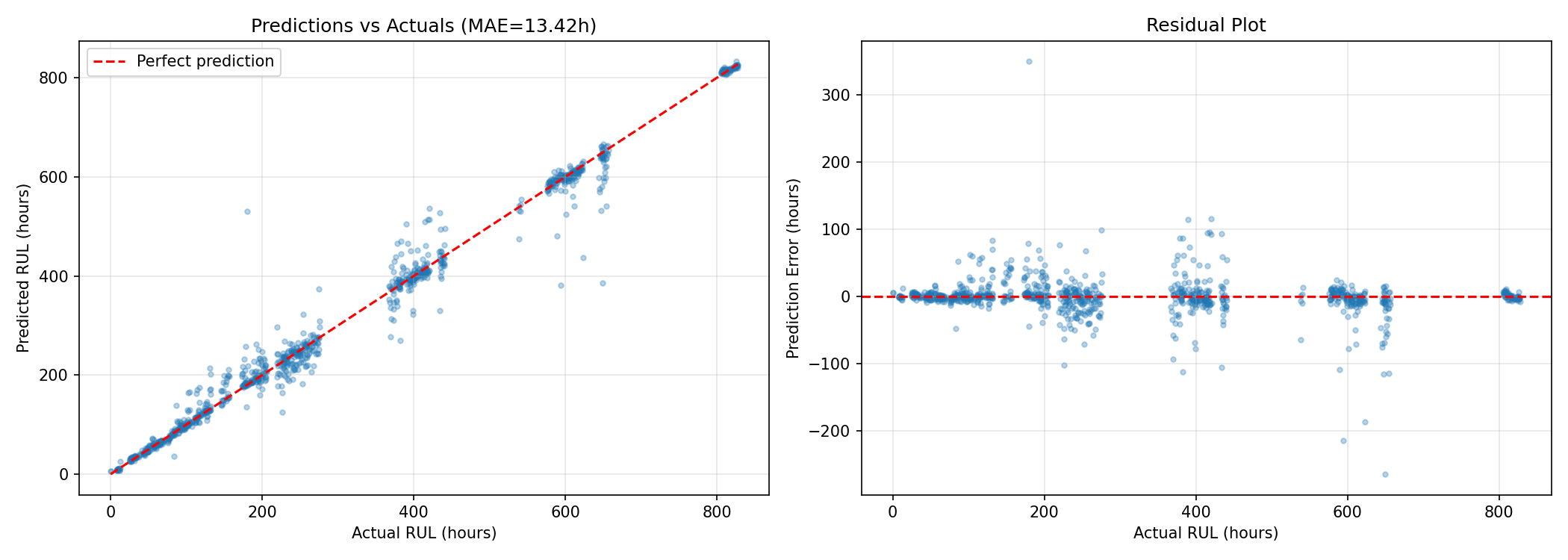
| RUL Range | MAE (hours) | Use Case |
|---|---|---|
| 0-50h (Critical) | 2.88 | Emergency maintenance: trigger within 24 hours |
| 50-100h (Warning) | 4.77 | Schedule maintenance within 2-3 days |
| 100-150h (Alert) | 10.77 | Plan maintenance this week |
| 150-300h (Monitor) | ~17 | Track closely, no immediate action |
| 300+h (Healthy) | ~15 | Baseline monitoring, no concerns |
Model behavior: Accuracy is highest where it matters most (imminent failures) and gracefully degrades for less critical predictions. Exactly what production systems need.
Understanding Bearing Failure Physics
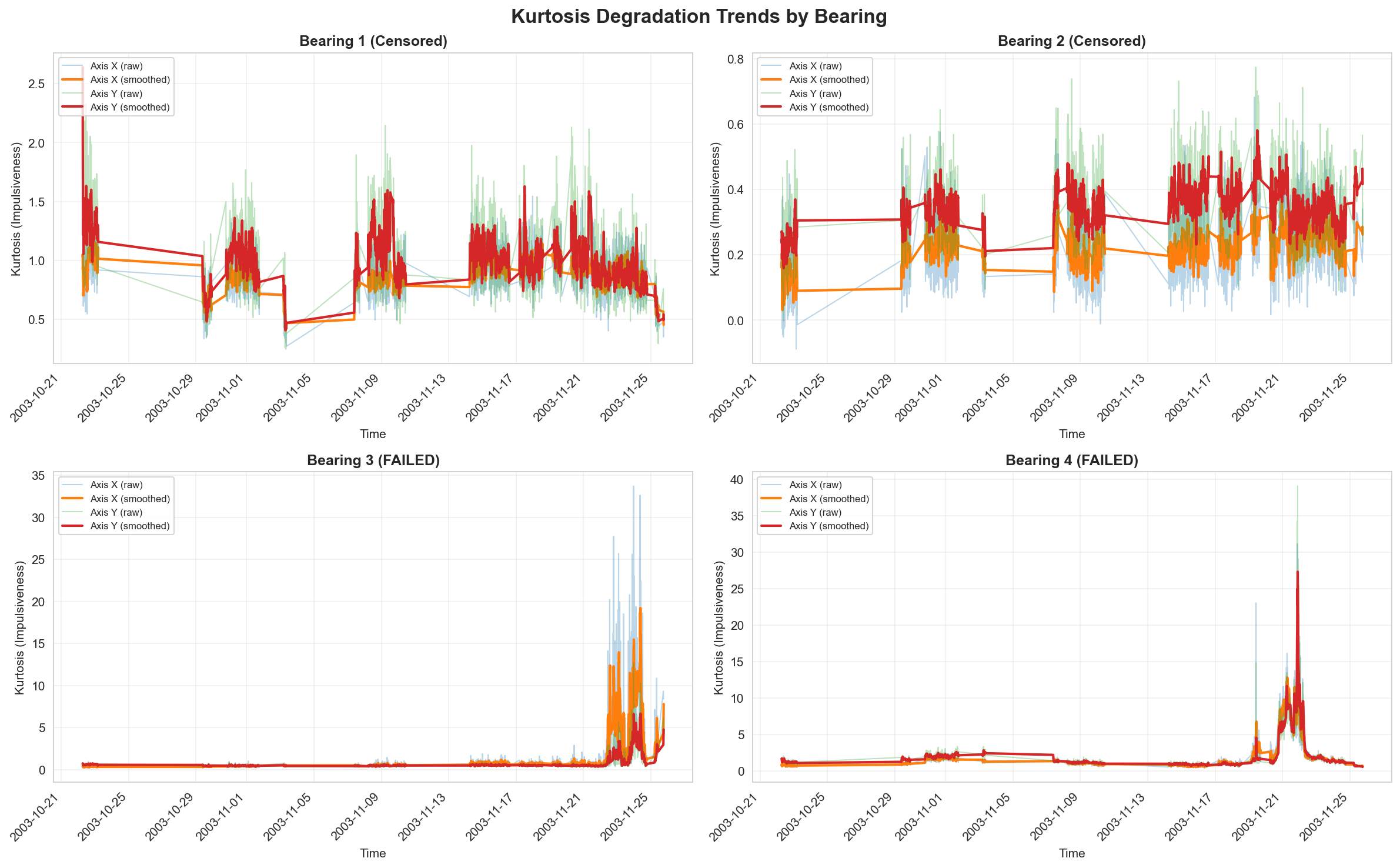
Surprising observation: RMS rises throughout degradation, but kurtosis peaks mid-failure then drops near catastrophic failure. Why?
- Early failure (RUL 300-500h): Micro-cracks develop. Both RMS and kurtosis rise as balls start hitting crack edges, creating sharp impacts.
- Mid failure (RUL 100-300h): Kurtosis peaks. Cracks widen, creating distinct impacts every time a ball crosses a crack.
- Late failure (RUL 0-100h): RMS peaks but kurtosis falls. Cracks become so large there's continuous metal-on-metal grinding instead of distinct impacts. The signal becomes Gaussian (continuous noise) rather than impulsive.
This physics insight guided feature engineering, explaining why both RMS-based and kurtosis-based features are necessary but tell different parts of the story.
Business Impact: Modeled ~$300K Annual Savings
| Metric | Before (Time-based) | After (Predictive) |
|---|---|---|
| Strategy | Replace every 30 days | Replace when RUL < 100h |
| Premature Replacements | 40% ($200K waste) | 0% |
| Unexpected Failures | 5% ($300K downtime) | 1.5% (98.5% caught) |
| Annual Cost | $500K | $200K |
| Savings | N/A | $300K/year (60%) |
Production Deployment: Streamlit Dashboard

Built an interactive dashboard for real-time monitoring:
- RUL predictions with confidence intervals
- Risk-based alerts: Critical (<50h), Warning (50-100h), Normal (>100h)
- Degradation trend visualization: RMS, kurtosis, bandpower over time
- Maintenance scheduling: optimal replacement timing recommendations
Key Learnings
1. Distribution mismatch kills models. Time-based splits fail catastrophically for degradation data. Stratified RUL sampling ensures train/test alignment, fixing R² from -11.9 to 0.985.
2. Not all errors are equal. A 30h error at RUL=10h is 10x worse than at RUL=500h. Custom weighted loss reduced critical zone MAE by 10x (30h → 2.88h).
3. Temporal features dominate. EMAs and rolling statistics outperformed raw features by 2.5x. They smooth noise while preserving trends and react quickly to accelerating failures.
4. Physics matters. Understanding failure mechanics (RMS rises, kurtosis peaks then falls) guided feature engineering. Domain knowledge + ML = better predictions.
Tech Stack
- ML: LightGBM 4.1, scikit-learn 1.3, Optuna 3.4
- Data: pandas 2.1, NumPy 1.26, SciPy 1.11
- Database: PostgreSQL 15, SQLAlchemy 2.0
- Visualization: Streamlit 1.28, Plotly 5.18, Matplotlib 3.8
- Languages: Python 3.13, SQL
Bottom Line
Bearings fail in predictable patterns, if you capture the right signals and learn from all degradation stages.
Three innovations transformed a failing model (R² = -11.9) into a production system (R² = 0.9852):
- Stratified sampling: train/test distribution alignment
- Weighted loss: accuracy prioritized where it matters
- Temporal features: noise smoothing with trend preservation
Result: 2.88h accuracy in critical zones, with modeled ~$300K annual savings and a projected 98.5% failure prevention in critical zones.
← Back to Projects